How do solar panels work?
Solar panels are sets of photovoltaic cells that absorb energy from sunlight, creating electrical charges that move in response to the cell’s internal electrical field. Photovoltaic panels are grouped in fixed arrays or on trackers that tilt to follow the sun. For a more specific breakdown about photovoltaic cells, check out the Department of Energy’s guide. There is also a helpful video to learn about the inner workings of solar cells.
How long do they last and how much maintenance do they require?
Solar panels are relatively low-maintenance, and although it isn’t essential, cleaning 1-2 times per year can ensure optimal performance. During the winter, snow can accumulate on panels, so depending on the panels’ location, you may consider a few options including purchasing a snow rake, installing a snow melter to clear snow or writing off production in December and January. Read more about solar panels in the snow here.
Is my home’s orientation good for solar?
Roofs angled at a 15-40° pitch facing within 15 degrees of south are usually best for solar, but east and west facing can work, too. Proper orientation and angle will help you get the most out of your array. How much energy your home could generate from solar (and your potential corresponding savings) depends on how shaded your home is. If you are not fully familiar with the sun vs shade percentage of your house – there are tools to help! Google has developed a tool called Project Sunroof, which uses Google Earth imaging to analyze your roof shape, tree cover, and local weather patterns. The tool can also incorporate financial incentives, and thus use all the data to estimate your potential savings from switching to solar.
Is my roof structurally ready for solar?
Beyond the orientation and shade of a roof, the structural integrity is another crucial element of assessing it as a candidate for solar panels. As solar panels can last 30-35 years, it is important to ensure that your roof is in good condition and not in need of replacement.
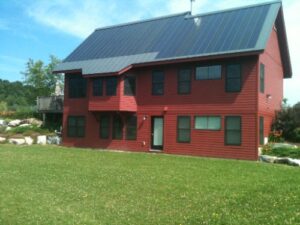
While solar panels can be installed on most any type of roof, certain roofing materials like wood and tile are more brittle, which could lead to higher installation costs. A newly installed asphalt shingle roof is a good candidate for solar, as it provides a durable and cost-effective surface for mounting. The best roof type for solar are standing seam metal roofs as they have a lifespan longer than solar panels and the panels can easily be attached without penetrating the roof.
If you decide that your home is not well suited for solar, it is worth considering buying into a community solar project – see more about that below.
What type of solar panel is best for my home?
There are many factors to consider when considering your solar array including type of panel, tracking vs not, as well as elements such as space available for mounting, budget, aesthetics. When considering the type of panel, the question of ‘efficiency’ comes into play. Your Energy Navigator can absolutely talk through the options available with you to help you make an informed choice.
With solar displays, efficiencies refer to the percentage of solar energy converted to usable power. Understanding that the sun produces a vast amount of power in a day, it is understandable that panels can only absorb a certain percentage e.g., 20% means 200 watts from 1000W/m² of sun. You will note that the different panels below have different efficiencies – these efficiencies were determined by a study on solar cell material. Read the article here.
Type of Solar Panel – Monocrystalline, Polycrystalline, or Thin-Film?
Monocrystalline panels are the most efficient and generally the highest quality, but consequently, can be the most expensive. They are constructed from singular crystals of silicone. Their efficiency is around 26%. If you have a limited amount of space, monocrystalline panels are the best option.
Polycrystalline panels can be more cost-effective but are less efficient. They are made from silicon fragments (rather than the singular crystals of monocrystalline), hence their lower cost. Their efficiency is around 22%. As they function at a slightly reduced efficiency, you may want more panels.
Thin-film panels are the least expensive, and are portable and flexible. They are less efficient, but are the most resilient and best suited for RVs and irregular roofs. Due to the priority on portability and flexibility, the materials they are produced with vary. Their efficiency varies from 13.6% to 22% based on the specific type (amorphous silicon, CdTe, and CIGS). They are a common choice for community solar systems.
Tracking or fixed?
‘Tracking’ refers to the ability for a panel to move its directionality to follow the path of the sun, rather than a ‘fixed’ solar panel which faces a single direction. Due to the movement, tracking solar panels generate more electricity and thus fewer panels are required to produce the same electricity production. Tracking systems can be costly, require more maintenance, and are only eligible with ground-mounted arrays.
Fixed arrays are more common for home solar arrays, because of their lower cost and maintenance requirements. For many homeowners, it may make more sense to invest in more fixed panels (especially if you aim to put the array on your roof), rather than planning to install a tracking array.
Read more about the pros and cons of trackers, and the different types of trackers here, and discuss them with your Energy Navigator.
What is community solar?
Community solar consists of solar projects that send energy to multiple customers via an off-site solar array. Community solar subscribers pay a monthly subscription fee in exchange for a share of the electricity generated by the project. Just like with home solar projects, community solar can generate excess energy, in which case a local utility will purchase that energy and send energy credits to subscribers. Community solar is a good option if you are a renter, can’t afford your own solar panels, or live in a place that is poorly suited for solar.
Read the Department of Energy’s guide to community solar here.
Your ability to utilize a community solar project is based on your proximity to these existing projects. As of June 2025, Vermont had 30 community solar projects, two of which are located in Addison County. Check out the community solar dataset here.
How does energy buyback work? What is net metering?
About 20-40% of the energy produced by solar panels is excess (meaning that the amount generated is beyond what a home would need at that moment). When this happens, net metering allows you to use the energy you need, and exchange the rest back to your power utility for energy credits – this system is known as ‘net metering’. These energy credits can be utilized to power the home when solar generation is lower (such as at night or on a cloudy day).
A bi-directional meter measures how much energy is being supplied and generated. Net metering can significantly reduce electricity bills for individual households and enhance the stability of the grid as a whole by balancing supply and demand. Read more about the benefits of net metering here, as well as Vermont’s net metering policy here.
Because solar is relatively popular in Vermont, power companies are reaching their net metering capacity in some areas. However, Green Mountain Power has said it will continue to accept net metering applications. Other areas, however, particularly in Addison County, are further from capacity, and are well suited for net metering (namely Ferrisburgh, Monkton, Starksboro, Goshen, Leicester and parts of Middlebury and Salisbury). Check out the map of Vermont’s net metering capacity here.
Do I need a battery backup system?
A battery is not a required part of a solar array, but is something to consider in your planning. A battery allows you to store some of the excess energy your solar panels create if you don’t want to (or unable to) sell it back to the grid. Similarly, in case of the grid going down, you will still have power. However, this does come at a cost -the average cost of a battery system for a residential battery system can range from $7,000-14,000. Due to the cost, batteries are typically only a good choice for utilities with demand charges, time-of-use rates, or ones that don’t offer net-metering. Read this guide to learn more about why a battery may, or may not make sense for you.
Some utilities, such as Green Mountain Power (GMP), offer battery rental programs for a monthly fee. As part of this agreement, GMP may draw power from the battery at peak load periods, replacing it later, usually in the middle of the night when loads are lower.
Sources referenced: